A SOCIAL SKIN
/ A TRANS_ARCHITECTURE
2026


120m2 WALL RELIEF FOR THE SOUTH AFRICAN RESERVE BANK
BY ROLAND GUNST a.k.a. JOHN K COBRA & GILBERT BALINDA ARCHITECTS (SOUTH AFRICA)
I was commissioned by the South African architecture firm Gilbert Balinda Architects to design a 120 m² wall relief for the central hall of the new South African Reserve Bank Museum, which opened in May 2026.
Trans-Monuments: Architecture nurturing the wellbeing of human kind
At the heart of my wall relief design lies my artistic research method: Trans-Architecture. Trans-Architecture is the performance of critique on human, environmental and animal rights organised on heritage sites to challenge power dynamics and heal the individual, the community and the human ecosystem.
As architecture is always programmed by ideology, it is imbued with a purpose that should always serve the well-being of humankind and its living environment — the human ecosystem. The architecture of South African Reserve Bank Museum is serving the well-being of humankind.
In Europe, heritage sites typically consist of stone monuments and statues that symbolise capitalism, imperialism, expansionism and colonialism. In Africa, however, memorial sites often take the form of objects or human bodies known as 'power figures'. These power figures are containers or vessels of identity or spirits of forefathers, activated through performances and rituals, to heal the individual or community.
Trans-Architecture is an artistic, political and spiritual intervention on heritage sites and power figures, as activists and African spiritual specialists have done for centuries. Unlike some activists, however, Trans-Architecture does not damage these symbolic spaces; instead, it uses all the tools of theatre, art, ritual and disguise to express opinions through subtle and temporary alterations to the outer layer of heritage sites.
Drawing on Trans-Architecture, we designed this central aluminium cube to be a monolith, a monument onto which we carved critiques of past and present societal issues, while also proposing a new vision for future generations.
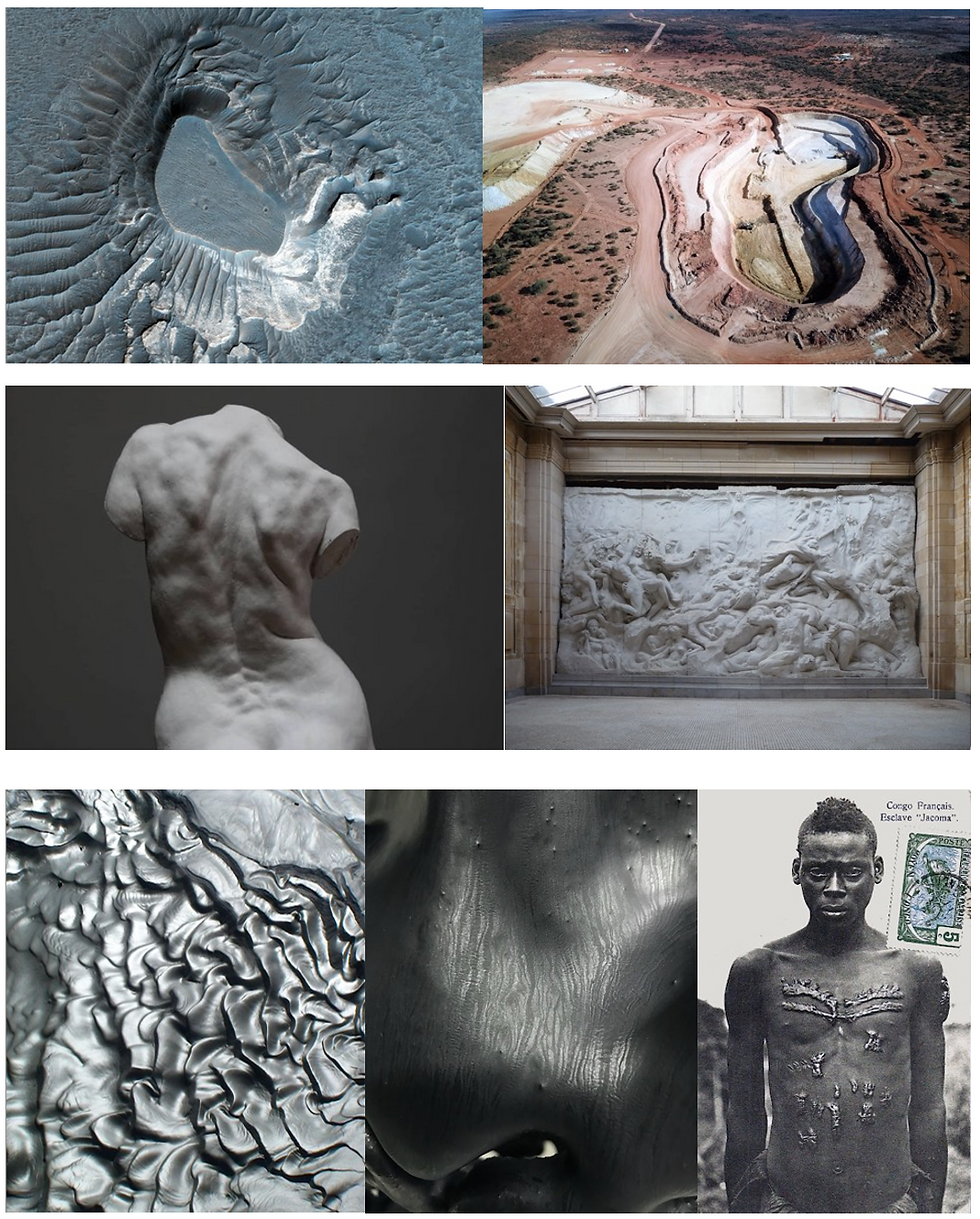
The design is inspired by the centuries-old cultural tradition of scarification among the Luba community in the Democratic Republic of the Congo and many other African communities.
Among the Luba, scarification and hair-styling are used by both sexes as ways of encoding memory about a person's history and their place in society. As the memory grows with age, more 'information' is added. The shape and colour of one's coiffure for example can be altered to signify changes in marital and occupational status. In this sense, the body becomes a book; the skin is a text both to be written and to be read by others. Indeed, the original Tabwa verb 'to scarify' (kulemba) has been adopted to mean 'to write' since the introduction of literacy. (Memory: Luba Art and the Making of History by Mary Nooter Roberts and Allen F. Roberts)
Reality is a multi-layered geological, biological and social construction.
Minerals form the fundamental chemical basis of life on Earth. They provided the structural templates for the first organic molecules, formed the primordial environment in which life began, and continue to drive essential biological functions to this day. Without minerals, the metabolic processes that sustain living organisms would be impossible.
Reality is a living membrane where countless layers of human perspectives, identities and experiences accumulate, interact, merge, compete and regenerate over time, creating the present landscape. The landscape is what we see of reality: the skin, the outer layer.
Human life and civilisation is born from minerals extracted from nature. Minerals and Ore Minerals are necessary for the development of currencies, which are not only economic tools, but also foundational social and cultural artefacts. As well as functioning as a medium of exchange, they act as a tangible expression of national identity and a system of moral and social obligation. They also drive interpersonal trust, shaping how human beings interact with and assign value to the world around them.
The aluminium outer layer, the skin, of the monolith is perforated with patterns, an alternate form of sculpting inspired by pointillism and the round shape of a metal coin and tokens, with the identity, history and future ideals of the human ecosystem. Its design symbolises and reiterates the ancestral symbiosis between humans and nature (the biological and mineral realm). These groups form a large grid of interweaving and merging layers of geological, social and biological matter, creating a robust social infrastructure in which humans thrive. The fluid architectural design of the mural relief acknowledges nature as an equal partner with human beings, with both sharing equal rights, respect, and agency on this earth.
Reinstating this ancestral vision brings with it a greater responsibility for humans. Assisted by the spirits of their ancestors, humans must preserve and maintain this equilibrium given their dominance over nature. The impact of human intervention on humans and nature is deeply inscribed like scarifications on our bodies, nature and the Earth's surface / skin. It is visible to the naked eye at macro and micro levels, as seen in mining sites where minerals are extracted.
From an aerial view, the human ecosystem resembles human skin with scarifications of different organic shapes and depths.